Year in Review
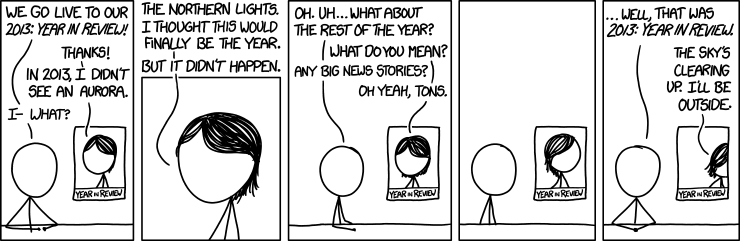
XKCD posted my year end review for me. Iceland, I may never forgive you.
Last night I had trouble sleeping. I had a bad stomach ache last night and this morning I woke up about an hour before my alarm went off and couldn't fall back asleep to save my life. Pretty common for the first day of school. Teaching-related sleep anxiety has been a staple of my August-June life for the past six years.
But today was different. It was indeed the first day of school in my district, but it was the first day that I really didn't go back to teaching. Yes, I worked all summer in my new role, and I even did it half time (sort of) last year, so it's not like it's completely new. But today was the first day that I really officially did not go back as a teacher.
Lots of people have been asking me how it feels. I thought today would be weird and milestone-ish. But it turned out to be just another day at the office. Except for the weird sleep last night (maybe I just woke up early because my roommates were getting up at a work hour for the first time today?), nothing felt different. On Saturday when I helped a friend set up her classroom, it didn't really feel weird that I wasn't setting up my own. The only time I have felt weird was about a month ago when I was at Target and I started to look at the school supplies and then realized I didn't have to. It wasn't necessarily happy and it wasn't necessarily sad. It was just a small jolt out of a usual August routine.
Will it hit me at some point? Probably. It's hard to imagine that quitting the career I intended to do for a lifetime wouldn't emotionally screw with me in some way or another. Is that a good thing? Probably. I still unquestionably believe that teachers are the most important part of our educational system and that everyone else in education should just be working on how to support them. So I definitely see myself as some level of failure for giving up on doing that most important job. I just hope that as I continue in a different direction that I do everything I can to take care of the teachers who take care of our kids. Maybe if I can make some teacher's life easier and her job more exciting, she won't burn out like I did.
Yesterday a couple of students came into my class, saying they had been sent by their teacher to retrieve his Purple Binder. It took me a second--the only binder I'd borrowed from that teacher was a binder he probably wouldn't need, especially not in the middle of class. Then I remembered what the Purple Binder contains: the greatest classroom management strategy in the world.
You know those days when kids are getting really squirrely and annoying and you wish you could just send them to run laps? Often on those days the kids aren't doing anything completely out of line, so turning their behavior into a discipline issue or kicking students out of class would just make everything explode. You want to avoid a negative interaction for your own sanity and theirs. Enter the Purple Binder. Kids love running errands for their teachers, so pick the 1-2 of the most annoying kids and ask them to go to Ms. _____'s room to see if she has your Purple Binder. Ms. _____ tells them, sorry, she doesn't have the Purple Binder. She thinks she gave it to Mr. _______ (who happens to teach all the way across the school). Turns out Mr. _____ doesn't have it either--he is sure that he gave it to someone else. After traipsing back and forth across the school a couple of times, the kids will probably give up, but in the meantime they will have burned off all their energy. And they will never know that the Purple Binder does not actually exist.
Bonus: getting a Purple Binder visit makes my day. Maybe it's mean, but I love seeing how confused/exasperated kids get when I send them to yet another classroom on a wild goose chase.
O: Can I go to the bathroom?
Me: Do you have a bathroom pass?
O: But your eyes! Your eyes are as blue as the deep blue ocean.
Me: You still need a pass. And your sucking up doesn't even make sense because I have brown eyes.
O: Oops, I mean, your eyes are as brown as the stain on my--
Me: That's supposed to flatter me?
O: Wait! I wasn't going to say 'underwear'!
I know teachers aren't supposed to have favorites, but N. happens to be one of mine. He has an unbelievably quick and sharp wit. I know I can always count on him for a perfectly-timed smart remark.
The other day he was working on homework in my room after school and was whining about not wanting to do the problems and arguing (in a nice way) about why they weren't worth doing. He turned to the ludicrous circular logic he so adores, and this conversation ensued.
Me: You should work for Fox News.
This video is so out-of-touch. The other day I overheard a group of principals talking about how "A" is the new "C" for multiple choice tests. This girl should choose A.
From the one student's "About the Author" section of a recent project in my class:
"I am the type of person who doesn't typically ask questions when I am confused on the subject, however, after doing this certification [project], I learned that sitting there and copying things off the board doesn't help me learn and I would always not understand things that we were learning. So, I started asking questions when I didn't understand something and I feel like that's what everyone who is confused should do because when they don't understand something and just sits there copying what the teacher tells them, it's not going to help them learn anything when it comes to something that is in the real world."
From another kid's "About the Author" section:
"I want the world to know that im a cool person and that im a boss. I want respect from a lot of people. I want everybody to pay me cash and give me awesome things. I want all the ladies to love me."
(Obviously, sic)
In no particular order:
"There is a lot of neon along I-94."
"This grocery store has so many preservatives."
"Since when did girls wear tube dresses to Charley's? In my day we saved 'dressing up' for Rick's."
"Do I pick up a Michigan accent when I'm back here?"
"I'm glad I went to college in the era when dressing up meant black pants and a tank top."
"Is that a typo or is beer really that cheap?"
"Since when did Really Hot Guy From High School become Super Hot Guy From Wharton?"
"There are a lot of white people here."
"French fries and ranch: a trend that should spread west."
"No, really. I can count 26 people from where I'm standing and three are not white."
"Conor O'Neils: still undeserving of its prime spot on Main Street."
"NYPD pizza: still amazing."
"If I had to guess, I'd predict that NYPD chicken rolls are less delicious prior to 3am. Good thing I will probably never find out."
"Michiganders really do drive better than Californians."
"Was 30 degrees always this cold?"
"I miss mile marker signs on the freeways."
"So many people in crew neck sweatshirts, mom jeans and sneakers. Male and female."
"So many strip malls."
"Pizza and ranch: also worth spreading."
"Freeways here are dark. And have very few lanes."
"I picked good friends in high school and college. Still blows me away."
"There are a lot of billboards on I-94 for injury lawyers,"
I've gotten into the habit of ending every test/quiz with the question "What do you want your teacher to know about how you're feeling right now?" It brings out some good responses that I think kids might be willing to say out loud or approach me with in person.
Yesterday a girl concluded her response to this question with "#justsaying." I hope this means she's tweeting about geometry class. I hope it doesn't mean she's trying to do every math problem in under 140 characters.
Today at lunch, one of my students was trying to convince me to vote for Romney.
N.'s reasoning: "He has such a cool name! I mean 'President Romney'? Doesn't that sound cool?"
Me: "You mean 'President Obama' doesn't sound cool?
N: "And look at his hair. Romney has such good hair."
Me: "I don't think good hair is an indication that someone will be a good president."
N: "All the good presidents have had good hair and all have been Republican. Well, except Abraham Lincoln. His hair was scraggly. But look at Reagan! Look at George Washington! He had that weird ponytail thing."
Me: "Washington wasn't a Republican."
N: "All I'm saying is that Romney would be a good president because good hair makes you a good president."
H (another student who has been silently shaking his head in the corner): "Good hair doesn't make you a good president. Good hair just makes you a Republican."
The real question is: how many registered voters will be casting their ballots for the exact same reasons N. gave me?
I spend a lot of time reading education books, attending education talks, and generally trying to access and think about big ideas in education. While I like spending time with all of these ideas, it's rare that the ideas feel new. Even when an author's perspective deeply resonates with me, it usually feels like another iteration of the same old idea.* However, Paul Tough is now two for two in completely blowing my mind with his reporting about education.
First I read Whatever It Takes, the story of Geoffrey Canada and the Harlem Children's Zone. I read the book in a day and the first thing I did after closing the cover was to make a large (for me) donation to the HCZ. Then this week's episode of This American Life, "Back to School," was based on Tough's new book about the role of "non-cognitive" factors (things like perseverance, attention span, self-management, etc.) in determining a person's success. Both times, the ideas that Tough brought to life articulated ideas that have been loosely swimming around in my head but that I could never piece together. As I was listening to This American Life today and when I read Whatever It Takes I found myself thinking "Yes! Of course! That's it!" The ideas felt fresh and innovative, but also realistic and highly effective. Again, that's not something I feel very often when I listen to education research.
Moreover, Paul Tough's work makes me feel optimistic. This is another feeling I rarely have about education. Even when things go well in the tiny microcosm of my own classroom, I feel the crushing weight of just how ineffective I am in the larger scale of things. I serve so few kids, and even for those kids I'm such a small part of their lives. For the little part I play in their lives, there is only so much I can do both because one person can only make so much of a difference, but also because of structural factors in the education system that make it harder for me to be a good teacher for kids and harder for them to get the most out of their schooling experience. And beyond that, what about all the non-school-related things in their lives? Even if I'm the most amazing teacher in the world (which I am not), it only has a certain impact when a kid doesn't have enough to eat, lives in an abusive household, can't afford to go to college, is fighting to stay out of gangs, gets pregnant... the list of things I can't control is overwhelming. And then there's all the research about how kids' general life outcomes can usually be predicted by what happens in just their first few years of life, or even the family they're born into. If I first meet at kid at age 15, is it too late? Are their fates already sealed? Am I just a weird kind of hospice worker, helping kids make a slightly less miserable transition into a pre-destined-by-birth cycle of poverty, imprisonment, and/or trauma? Paul Tough's books tell me no, all is not lost. The damage that has been done to kids from underserved communities is real and can have devastating consequences, but the damage is not inevitable.
Thank you, Paul Tough, for giving me a reason to not quit my job.
If you haven't listened to the This American Life episode, do it immediately.
*I get the impression that the findings behind almost all education research ever boils down to the solution of "know your students." This is a lovely idea and piece of advice; I absolutely agree that the most effective way for a teacher to support students is to know them better. The more I know my students academically, socially, emotionally, etc. the better I can serve them. However, this idea is so much easier said than done, so hearing over and over again that I just need to work on knowing my students doesn't actually help me figure out how to do that in a way that's manageable and realistic. But this is a whole other blog entry for another time.
From a student today:
"Ms. L., I think you're in a better mood when you wear jeans."
Of the many education quotes and adages I have floating around my head, one that consistently surfaces is George W. Bush's description of "the soft bigotry of low expectations." What does it mean when I have low expectations of a student? I see it sending two messages: (1) You're not smart enough to meet the high expectations that you see me holding other students to. (2) I've given up on you. The "I" in those statements could refer to me specifically, or to the "I" of a school or institution. I am honestly ashamed of some of the things I have let pass as "mastery" of content. It feels bigoted because it feels like I've already made the judgement that I've deemed them so incompetent that I don't think they can perform at a "real" level. It feels condescending because it seems like I'm lying to them to make them feel good about themselves. I feel like I'm no better than someone who writes them off in the first place. Maybe I even feel worse because I tried to earn their trust and then told them I didn't think they were good enough/smart enough/capable enough; the dagger hits closer to the heart.
But in trying to avoid the soft bigotry of low expectations, I keep coming back to two questions: (1) What are high expectations? What does it mean for something to be rigorous? How do I know I'm challenging a kid? (2) What does it actually look like to hold a kid to high expectations? I can give lip service to my expectations all I want, but what does it look like in practice to hold those high expectations?
And those are the easy questions. Like every good adjective, "high" is subjective. I think most people would agree that high expectations for sixth graders are (and should be) completely different from high expectations for 12th graders. Sixth graders are in a different place emotionally, developmentally, and academically. You wouldn't stick a sixth grader in a calculus class and pride yourself on how well you're challenging the kid. I would make the argument that my students are in a different place, at least emotionally and academically, than other 10th and 11th graders in, say, Palo Alto. So what does it mean for me to hold high expectations for my students, given that those expectations will be different from high expectations at Palo Alto high schools? If my expectations are different for kids at my current school than they might be at another school, am I inherently succumbing to the soft bigotry of low expectations, especially because my students are almost all children of color from low-income families?
Then there's the piece about what happens when you try to hold students to high expectations. Let's say I try to be that tough teacher and hold my kids to agreed-upon standards of high expectations. For example, what if I started teaching my geometry according to IB standards? Kids would fail my class. Maybe that's being pessimistic, but I also feel like it's realistic. I know it's my job as a teacher not only to set high expectations, but to help kids meet them. At some point, though, the kid has to do some work. I don't know enough about scaffolding or adolescent development or motivation or any of that to get students to put in the level of work that's required for them to compete at the same level as those Palo Alto kids. And even if I did know, I don't think I have the energy. If I compare it to sports, I could set a goal for myself of running a marathon in 2 weeks, which is for sure a high expectation. Maybe--maybe--I could even meet that goal if I was motivated enough to spend all of my time training and drop everything else I'm doing with my life. But that's unrealistic. The response to that is, "Set a goal to run a marathon in 6 months--that's reasonable." Great, but I only have a limited amount of time with my students. The marathon they have to compete in is coming in June (or May, if we're talking about state testing, or February if we're talking about the High School Exit Exam), so even if they're completely out of shape, they still have a limited amount of time.
Happy new school year. How do I set expectations for myself that aren't setting me up for failure and/or burnout?
Seems like this is the right time to blog; tomorrow is my first day with students at a new school.
Things I'm feeling nervous about:
It's too obvious of a statement to say that my new job is different from my old one. Of course it is--I'm in a new role, a new city, a new type of school and district, a new set of educational priorities, and a whole host of other things. I switched jobs precisely because I wanted something different. But there's a difference that I keep noticing that I didn't really think about when searching for a new job or when I accepted the position: there are so many more people of color in my new workplace.
Better late than never.
In season 6, episode 20 of the sage TV show "How I Met Your Mother," Robin describes the phenomenon of "graduation goggles," those nostalgic rose-colored glasses you get when about to end a life situation or phase, even if you know that phase was pretty terrible. Even if high school was nothing but bullies and insecurity, right before it ends you can't help thinking that you don't want to go. Okay, it's a silly source for the name of this 'phenomenon,' but in the past few weeks I've appreciated having something to name the feeling I've been experiencing.
I've known for a long time that I was unhappy at my job. There were many reasons why, and it was hard to parse out the source of many of my frustrations. Teaching is a complicated thing because even the best and happiest teachers, those who love their jobs and can't imagine doing anything else, are stressed out and unsuccessful. Teaching is a job where you will always fail at something. You will always fail in the short-term: there will be things you wished you had done differently in any given class period to better support students. You will fail in the long-term: there will always be kids in whom you see nothing but greatness but who fail to meet the bar you've set. Kids will disappoint you in ways you never imagined possible. It is the nature of the job that it is difficult and heart-breaking and that the amount of time and love you put in will never be enough. All of these failures wear on me. And then this was compounded by challenges specific to my school. I had to (and still) wonder: is it the school that's doing me in or is it the profession as a whole? Is my school not the right fit for me or am I just not cut out to be a teacher?
Coming to the decision to leave my school was a gradual process. At first I thought I would stick it out one more year, four in total, to honor the goal of following my advisory for four years. I began with them in 9th grade and after three years together I see them as my own. I have come to love each of them deeply and unconditionally. Every time I moved closer to making the leap away from my school, my advisees have been the (sometimes literal) voice reminding me of my obligation to stay. But the challenges and stresses of my school continued to build up and break me down until they outweighed the commitment I felt to my advisees. Is that terrible? Call me a deadbeat advisor; I chose my own mental health and long-term career prospects over whatever I felt for them. There are lots of arguments as to why the kids will be fine--the school will still support them, they'll all still get into college, I can be a better support if I'm not drowning in my own poor mental health, etc. But I still feel guilty.
In the last week of school, the graduation goggles hit hard, especially as I thought of my advisees. I sat at graduation watching current 12th grade advisors choke back tears and beam with pride as they handed out good wishes and diplomas. As I remembered I am the one who gave up that opportunity to sit on that stage and send my babies into the world, I couldn't help but think, "Maybe one more year here wouldn't be that bad." Earlier in the week as I cleaned out my classroom and realized that I'll never again get to use some of my curriculum and structures in the same way, I thought, "Maybe one more year would be just what I need to get it right." As I said good bye to colleagues who have become good friends, I wondered, "What if my next school doesn't have a Maura?" The graduation goggles made me forget the reasons why this job nearly killed me. It obscured all the times when I cried in the faculty bathroom or prayed I would get in an accident on the way to school so I wouldn't have to go to work. However, being able to name the feeling helped me make more sense of it and remind me that I am leaving for good reason. It also helped me remember that I always have a moment of panic right before I dive into something new--I remember second-guessing myself as I got on the plane to New Zealand and as I moved into my apartment at Stanford, both times thinking about all the things I'd miss about whatever had come before.
Not to say that my hesitation about status quo changes is always a bad thing. I worried I'd made the wrong decision when I started the job I'm now fleeing and, well, maybe I should have listened better to that instinct. Who knows what will happen next? What I do know I know is this: my decision to leave my school is scary, but feels right. More importantly, the circumstances and decisions (mine and others') that have led me to my new role are an incredible combination of acting on my beliefs and of pure luck, so everything feels completely right about where I'm going. No doubt there will be new, unexpected challenges that make me to grumble about how kids/ policies/ administrators/ colleagues/ resources/ etc. were never like this at my last school, but I hope these will be outweighed by unexpected surprises that confirm I'm in the right place. Even through the graduation goggles, I'm eagerly awaiting what's coming next.
One point of contention for people of mixed race heritage has always been racial reporting on demographic surveys. From my own personal experience and from hearing the stories of many, many others, I know that there is always a strange, uncomfortable feeling that wells up whenever I am asked to report my race. It's not that I'm opposed to collection of demographics--in fact, I feel proud and patriotic when I get to participate in the US Census every 10 years, and am appalled by the recent House of Representatives vote to eliminate the American Community Survey (write your senator to stop the madness!). Specific to racial identification, I very much want people to know how I describe that important part of my identity. But every time I start to read the race question on a form, I know that I am not the one choosing the desctiption. The boxes choose. Who knew that the words "check one" could be so traumatically defining to a young child (or always-growing adult)? Specific memories stand out from very early on about dealing with this question. It was the question on every standardized test that everyone knew the answer to except me. Asking how to fill out that section made you look as stupid as asking how to spell your name (also an issue for me in the standardized testing context). For a mixed person checking only one box means, at best, knowingly providing inaccurate or misleading information. At worst it means publicly documenting which parent you love more or which side of your family you would erase from the past. It means succumbing to the ways that others have spoken for you against your will and admitting to shameful fantasies about about wishing away a part of your very being.
I remember filling out my SAT registration and asking my sister what she marked for the race question. How could I negotiate my desire to follow-rules (you can only check ONE) with my desire to be truthful to both the survey-takers and to myself? My sister's response still drives my box-checking decisions to this day: "I still check both. Sometimes I check 'other' also. If it jams up the machine and they have to read it and enter it by hand, good. Then someone will be forced to notice what's going on." I still check as many as I want, no matter what it tells me to do. That's me, sticking it to The Man. Sadly, as an adult I've learned more about the many ways The Man sticks it back to you and know that whichever data-collector has to deal with my insolence will probably just choose one race for me based on whatever will most benefit the data-collection agency. I have seen this happen at my school when collecting data about my students and it still weighs on my conscience the many times I've not spoken up in defense of kids and their families who were just trying to explain who they are. I'd rather honor the self-identification wishes of a real human being than worry about whether some final statistics will add up to more than 100%.
Fortunately, I have seen change in my lifetime and now it is much more common to see "check all that apply." Of course there are glaring issues with the racial categories one gets to choose from, not to mention the delineation of "Hispanic" as an ethnicity but not a race, but expanding the number of boxes I can check is at least a step in the right direction. I like to think that the data collected from the 2000 US Census (the first time one could select more than one race) provided a positive, affirming demonstration of why this data is worth collecting.
What brought this all up today is a form where I saw something I'd never seen before:


Most of my celebrity crushes fall along the usual hot movie star lines, but somehow I developed a massive crush on one skinny, blonde, Mormon trivia nerd. So imagine my delight when I found out that Ken Jennings was speaking about his new book, Maphead, in Oakland.
Morgan and I with my hero:
.JPG)
.JPG)


