Showing posts with label California. Show all posts

Monday, December 03, 2012

At least one kid got it

From the one student's "About the Author" section of a recent project in my class:

"I am the type of person who doesn't typically ask questions when I am confused on the subject, however, after doing this certification [project], I learned that sitting there and copying things off the board doesn't help me learn and I would always not understand things that we were learning. So, I started asking questions when I didn't understand something and I feel like that's what everyone who is confused should do because when they don't understand something and just sits there copying what the teacher tells them, it's not going to help them learn anything when it comes to something that is in the real world."


From another kid's "About the Author" section:

"I want the world to know that im a cool person and that im a boss. I want respect from a lot of people. I want everybody to pay me cash and give me awesome things. I want all the ladies to love me."


(Obviously, sic)

Friday, November 09, 2012

Hashtag

I've gotten into the habit of ending every test/quiz with the question "What do you want your teacher to know about how you're feeling right now?" It brings out some good responses that I think kids might be willing to say out loud or approach me with in person.

Yesterday a girl concluded her response to this question with "#justsaying." I hope this means she's tweeting about geometry class. I hope it doesn't mean she's trying to do every math problem in under 140 characters.

Monday, November 05, 2012

Election Wisdom

Today at lunch, one of my students was trying to convince me to vote for Romney.

N.'s reasoning: "He has such a cool name! I mean 'President Romney'? Doesn't that sound cool?"
Me: "You mean 'President Obama' doesn't sound cool?
N: "And look at his hair. Romney has such good hair."
Me: "I don't think good hair is an indication that someone will be a good president."
N: "All the good presidents have had good hair and all have been Republican. Well, except Abraham Lincoln. His hair was scraggly. But look at Reagan! Look at George Washington! He had that weird ponytail thing."
Me: "Washington wasn't a Republican."
N: "All I'm saying is that Romney would be a good president because good hair makes you a good president."
H (another student who has been silently shaking his head in the corner): "Good hair doesn't make you a good president. Good hair just makes you a Republican."

The real question is: how many registered voters will be casting their ballots for the exact same reasons N. gave me?

Wednesday, August 29, 2012

Low Expectations vs. Realistic Expectations

Of the many education quotes and adages I have floating around my head, one that consistently surfaces is George W. Bush's description of "the soft bigotry of low expectations." What does it mean when I have low expectations of a student? I see it sending two messages: (1) You're not smart enough to meet the high expectations that you see me holding other students to. (2) I've given up on you. The "I" in those statements could refer to me specifically, or to the "I" of a school or institution. I am honestly ashamed of some of the things I have let pass as "mastery" of content. It feels bigoted because it feels like I've already made the judgement that I've deemed them so incompetent that I don't think they can perform at a "real" level. It feels condescending because it seems like I'm lying to them to make them feel good about themselves. I feel like I'm no better than someone who writes them off in the first place. Maybe I even feel worse because I tried to earn their trust and then told them I didn't think they were good enough/smart enough/capable enough; the dagger hits closer to the heart.

But in trying to avoid the soft bigotry of low expectations, I keep coming back to two questions: (1) What are high expectations? What does it mean for something to be rigorous? How do I know I'm challenging a kid? (2) What does it actually look like to hold a kid to high expectations? I can give lip service to my expectations all I want, but what does it look like in practice to hold those high expectations?

And those are the easy questions. Like every good adjective, "high" is subjective. I think most people would agree that high expectations for sixth graders are (and should be) completely different from high expectations for 12th graders. Sixth graders are in a different place emotionally, developmentally, and academically. You wouldn't stick a sixth grader in a calculus class and pride yourself on how well you're challenging the kid. I would make the argument that my students are in a different place, at least emotionally and academically, than other 10th and 11th graders in, say, Palo Alto. So what does it mean for me to hold high expectations for my students, given that those expectations will be different from high expectations at Palo Alto high schools? If my expectations are different for kids at my current school than they might be at another school, am I inherently succumbing to the soft bigotry of low expectations, especially because my students are almost all children of color from low-income families?

Then there's the piece about what happens when you try to hold students to high expectations. Let's say I try to be that tough teacher and hold my kids to agreed-upon standards of high expectations. For example, what if I started teaching my geometry according to IB standards? Kids would fail my class. Maybe that's being pessimistic, but I also feel like it's realistic. I know it's my job as a teacher not only to set high expectations, but to help kids meet them. At some point, though, the kid has to do some work. I don't know enough about scaffolding or adolescent development or motivation or any of that to get students to put in the level of work that's required for them to compete at the same level as those Palo Alto kids. And even if I did know, I don't think I have the energy. If I compare it to sports, I could set a goal for myself of running a marathon in 2 weeks, which is for sure a high expectation. Maybe--maybe--I could even meet that goal if I was motivated enough to spend all of my time training and drop everything else I'm doing with my life. But that's unrealistic. The response to that is, "Set a goal to run a marathon in 6 months--that's reasonable." Great, but I only have a limited amount of time with my students. The marathon they have to compete in is coming in June (or May, if we're talking about state testing, or February if we're talking about the High School Exit Exam), so even if they're completely out of shape, they still have a limited amount of time.

Happy new school year. How do I set expectations for myself that aren't setting me up for failure and/or burnout?

Sunday, August 26, 2012

T-minus one sleep

Seems like this is the right time to blog; tomorrow is my first day with students at a new school.

Things I'm feeling nervous about:

  • I don't understand tomorrow's bell schedule.
  • I somehow ended up with an advisory when I didn't think I was supposed to have one. 
  • WHAT DO I DO WITH SIXTH GRADERS???? They are so small. 
  • When my principal handed me my rosters, there is a student whose name he circled multiple times. 
  • When I left my classroom today, it was still in shambles. Will the guy I'm sharing with clean it up? 
  • I am so far behind on planning. Already. 
  • I don't know if I can make it through an entire day in heels. 
  • The posters I hung up in my room are unevenly spaced and it's going to drive me crazy, but I also re-hung them twice, so I couldn't deal with fixing them. By the time I'm ready to fix them, will I be able to find a ladder again? 
Things I'm feeling less nervous about:

  • Tomorrow's lesson is easy. And it doesn't matter if kids learn anything. 
  • My classes are teeny-tiny. 20 or 24 kids? Five or six groups? That's nothing! I had nine groups in my first geometry class. 
  • The coffee is sitting in the coffee maker and all I have to do is press "brew" in the morning. 
This is by far the least nervous I've ever felt, at least about the teaching part. Here is the thing that calmed me: a teacher nightmare. Almost without fail, before the beginning of the school year or before I'm about to teach a brand new lesson, I have a dream where the first day or new lesson plays out, and of course everything goes wrong. Earlier this summer I had one of those dreams. It was the first day of school, and in typical nightmare fashion dream-me had somehow screwed up my schedule and had forgotten that I had a first period algebra class. And there were visitors from some important organization observing our classes. Luckily, one of my new colleagues (who is a first year teacher!) took over for me. But still, not the way to start your first day.

But here's why I'm feeling better: in the dream, I took that time when my colleague was covering my class and started planning for my afternoon geometry classes that I realized I had to teach. And even though planning 10 minutes before a class starts is never ideal, in the dream I knew I had tons of resources to pull from. I knew exactly what documents to pull up, what copies I needed to make, what general run-down I could use to make sense of the lesson plan. The dream was definitely a nightmare, but it wasn't unbearable.

Tomorrow I know (think?) that I don't have a first period algebra class, I am planned for my geometry classes, and even though a researcher really is coming to watch my 5th period, I am not nervous about her presence. Does this mean I'm reaching a new stage in my teaching? In so many ways I still feel as green as ever.

Monday, August 20, 2012

Diversity Matters

It's too obvious of a statement to say that my new job is different from my old one. Of course it is--I'm in a new role, a new city, a new type of school and district, a new set of educational priorities, and a whole host of other things. I switched jobs precisely because I wanted something different. But there's a difference that I keep noticing that I didn't really think about when searching for a new job or when I accepted the position: there are so many more people of color in my new workplace.


I noticed it at our first math department meeting: out of the five teachers, only one was white. I noticed a similar ratio of white people sitting around that table at a district level team meeting today. At a district-wide leadership institute two weeks ago, the presenters were all black women and the among the participants, teacher leaders and administrators, the people of color far out numbered the white people. And there's diversity in the people of color. There are black people, Latinos, and Asians of various ethnic origin. There are people who are non-native English speakers, people born and raised in the city, and immigrants to the U.S. As I've been sitting in meetings and trainings, at least once a day I look around and realize just how many brown people I'm surrounded by. 

And it feels amazing. 

I don't know exactly how to explain why it feels so good to be around so many other people of color. My last school wasn't completely lacking people of color, but there was a very white feeling to the environment. Again, I don't know exactly how to explain it. But something feels really powerful now to be around people who look like me, especially when those people are leaders and administrators. Maybe it's the role modeling of "they did it, so can I." Maybe it's a numbers game that reduces stereotype threat. Maybe it's the physical representation of the district's acceptance of multiple points of view. Maybe it's the fact that my students are much more likely to have a teacher who they can relate to on a racial, ethnic, or cultural level. Or maybe it's that sometimes I need a space where I'm around other people who I don't have to convince that race plays an instrumental role in shaping our daily lives. 

Interestingly, although no one has mentioned race or diversity (in the context of the work environment), I already feel supported as a person of color in my new workplace, something I definitely would not have said at my last job. I wonder what's making that happen, and if the presence of other people of color is enough on its own. That presence definitely makes it easier, but I have trouble believing that's the whole story, in part because I believe that there are ways that a demographically all-white work environment could still be supportive of me as a person of color. I need to think more until I can come up with a more definitive statement of what's going on, but in the meantime I'll leave it at this: I love my new job. 

Tuesday, June 05, 2012

Check One

One point of contention for people of mixed race heritage has always been racial reporting on demographic surveys. From my own personal experience and from hearing the stories of many, many others, I know that there is always a strange, uncomfortable feeling that wells up whenever I am asked to report my race. It's not that I'm opposed to collection of demographics--in fact, I feel proud and patriotic when I get to participate in the US Census every 10 years, and am appalled by the recent House of Representatives vote to eliminate the American Community Survey (write your senator to stop the madness!). Specific to racial identification, I very much want people to know how I describe that important part of my identity. But every time I start to read the race question on a form, I know that I am not the one choosing the desctiption. The boxes choose. Who knew that the words "check one" could be so traumatically defining to a young child (or always-growing adult)? Specific memories stand out from very early on about dealing with this question. It was the question on every standardized test that everyone knew the answer to except me. Asking how to fill out that section made you look as stupid as asking how to spell your name (also an issue for me in the standardized testing context). For a mixed person checking only one box means, at best, knowingly providing inaccurate or misleading information. At worst it means publicly documenting which parent you love more or which side of your family you would erase from the past. It means succumbing to the ways that others have spoken for you against your will and admitting to shameful fantasies about about wishing away a part of your very being.

I remember filling out my SAT registration and asking my sister what she marked for the race question. How could I negotiate my desire to follow-rules (you can only check ONE) with my desire to be truthful to both the survey-takers and to myself? My sister's response still drives my box-checking decisions to this day: "I still check both. Sometimes I check 'other' also. If it jams up the machine and they have to read it and enter it by hand, good. Then someone will be forced to notice what's going on." I still check as many as I want, no matter what it tells me to do. That's me, sticking it to The Man. Sadly, as an adult I've learned more about the many ways The Man sticks it back to you and know that whichever data-collector has to deal with my insolence will probably just choose one race for me based on whatever will most benefit the data-collection agency. I have seen this happen at my school when collecting data about my students and it still weighs on my conscience the many times I've not spoken up in defense of kids and their families who were just trying to explain who they are. I'd rather honor the self-identification wishes of a real human being than worry about whether some final statistics will add up to more than 100%.

Fortunately, I have seen change in my lifetime and now it is much more common to see "check all that apply." Of course there are glaring issues with the racial categories one gets to choose from, not to mention the delineation of "Hispanic" as an ethnicity but not a race, but expanding the number of boxes I can check is at least a step in the right direction. I like to think that the data collected from the 2000 US Census (the first time one could select more than one race) provided a positive, affirming demonstration of why this data is worth collecting.

What brought this all up today is a form where I saw something I'd never seen before:


This brought up a lot of questions morally, emotionally, and mathematically. I am going to list a bunch of them, in no particular order, just because it got me thinking:

  • I think that being able to select more than one race is always preferable to forcing someone to pick one race, but what number is adequate? Two doesn't seem like enough, but a limit of 15 seems like an unnecessary limit. 
  • However, five is still a limit, so is that inherently too confining/controlling? 
  • Mathematically, why five? Would a power of two make more mathematical sense? 
  • From a data analysis perspective, what are the benefits of limiting someone to five choices rather than not limiting the number of choices at all? 
  • How many people actually check five races, especially given the list of options (I only see three out of the 19 that don't fall under the APIA umbrella)? 
  • Identifying with five races means going back relatively far in one's ancestry, so at what point in the family tree does one stop identifying with a certain racial identity? 
  • What aspects of a given race (and culture) get retained for people in a way that pushes them to identify with that race/culture? 
  • At what point in a genealogy do people stop identifying as mixed race and what sociocultural factors play into that? 
  • How do positive and negative reinforcement of claiming (or not claiming) a multiracial heritage impact one's desire to do so? E.g. do I choose to identify as mixed race more because it's become fashionable in recent years (positive reinforcement) or because the negative consequences of choosing two races have been reduced? Does the tragic mulatto want to choose one race so he can be fully accepted in a loving community or because he doesn't want to be lynched? 
  • How much of the rise in mixed race births is/can be attributed to an increase in interracial couples and how much to a change in the ways we identify ourselves (and the ways that society allows us to identify ourselves)?  
Please feel free to run with any of these questions and write a doctoral thesis out of it. Just be sure to send me a copy.

Monday, May 14, 2012

Super Cute

One of my favorite things about my school is that we have spirit day every Friday. Last week, each mentor group got to choose their own theme. Usually my mentor group (thorough all fault of my own) lacks spirit when it comes to this sort of thing, but this time they were all in. (Maybe because they know that spirit days are one of my favorite things ever?) We voted on a superhero theme, so E. bought masks for everyone and I brought in felt and markers so we could make L's to pin on capes and shirts. Look at how adorable they are! We were by far the most spirited, most awesome mentor group of the day (sorry "Jeans and a white t-shirt" group). 


My favorite part was how much they got into it making the costumes. Multiple kids commented that it was our most focused, most productive mentor time in three years. I do not disagree.  As soon as E. passed out the masks, everyone put them on and got to work. 

 
And then they stayed in costume. Even superheroes have to take tests.  (Another teacher snapped this for me from our office window). 
 

Sunday, April 22, 2012

What is... awesome?

Most of my celebrity crushes fall along the usual hot movie star lines, but somehow I developed a massive crush on one skinny, blonde, Mormon trivia nerd. So imagine my delight when I found out that Ken Jennings was speaking about his new book, Maphead, in Oakland.

Morgan and I with my hero:


Best autograph ever:

Tuesday, March 20, 2012

Another Addition to the Banned List

Awhile back I wrote a post detailing some of the phrases and teaching strategies I would like to see banned from our nation's math classrooms. There are always little things that make me wonder why a teacher chose a certain strategy ("When you multiply by 1 it stays the same because 1 looks like a mirror, so it reflects back the number." Do you think that kids couldn't reason out why multiplying by 1 doesn't change the value?). But there's been a big one coming up lately that's kind of been driving me out of my mind.

"Reducing" Fractions
I understand why we say reduce, especially when accompanied by the phrase "to its simplest form," but I what do you think of when you think of something being reduced? You think of something lessening, you think of it having not as high of a value, you think of it not amounting to as much as it originally did, etc. Kids in the US have a lot of trouble with fractions, particularly with the concept that fractions represent a specific type of comparison of a part to a whole. When one 'reduces' a fraction, an important conceptual aspect is that even though the numerator and denominator change in a way that lessens their respective values, the fraction as a whole does not change in value at all. To say that a "reduced" fraction is equivalent to its original form is kind of an oxymoron--I'd love to see a sale where the reduced prices are equivalent to the original prices. When we use the word "reduced," are we surprised that kids don't understand fraction equivalence?

So what's the better option? Simplify. I love this word for a few reasons. First, it's preferable to "reduced" because it makes sense that a simplified version of something still has the same meaning/value as the original--now it's just in an easier-to-understand form. Second, I want kids/people to realize that any value can be represented in infinite ways, but we prefer some ways because they are easier to work with, compare, interpret, manipulate, or use in a given situation. Would you want to go to a restaurant where a sandwich cost $1-3^(0!)+300/(4x10)? Mathematically, there's nothing wrong with that price; realistically and emotionally, it's just annoying. If we simplify the price (not reduce because the restaurant still wants the same amount of money), we get a value that's more useful for our brains because the simplified value is easier to compare to what we already know about sandwich prices. Is  $1-3^(0!)+300/(4x10) expensive? Cheap? I have no idea until I simplify it to a value that looks like the other values I could compare it to. It's the same reason why we change the form (not the value) of a fraction when we need to add it to another fraction, or why we sometimes factor a quadratic into a binomial and sometimes multiply a binomal into a quadratic, or why we convert linear equations into slope-intercept form. Math is only useful if we can make meaning from it, so we manipulate values, expressions, and data sets until we can mold them into something that makes the meaning easier to find. We're not reducing anything when we rewrite 32/40 as 4/5; we're simplifying it into an equivalent form that's more useful.

Tuesday, November 22, 2011

Who Can't?

There was an interesting letter published recently from members of the Palo Alto High School math department about why they disagree with the proposed change to their graduation requirements that all students pass algebra 2. While I am disturbed by the tone of their letter and some of its implications, I will say that I sympathize with what they're dealing with because lately I have been questioning what some of my students are capable of.

Let me start out with a fundamental belief that I hold: all kids can learn and all kids want to learn. I don't believe that each person possesses a limited quantity of intelligence or potential. In fact, I don't even want to consider the possibility because of how that could impact my interactions with my students. I HAVE to believe that all of my students can learn because if I don't, what's the point? I also do not believe that the students are ambivalent toward learning; all of my students want to learn both because they want to be successful and because they value knowledge. Not every student translates their desire to learn into action that leads to success, but I do believe that they all want it.

The Palo Alto teachers state that for "objective reasons" some kids "can't" pass algebra 2. Coming from the belief that all kids can learn, that's a pretty tough statement to swallow. But I have also been wondering lately about some of my own students and, objectively, whether they can pass my class. I am shocked by the math that I'm seeing this year. I am used to kids coming in with weak math backgrounds, huge misconceptions, and severe lack of exposure to concepts one should know by 9th grade, but there are some really tough cases this year. For example, this weekend's homework asked students to measure the circumference, radius, and diameter of five circular objects at home. Then in class we used the data to explore the relationships between those measurements, blah, blah, oh look it's pi, etc. I knew that kids would measure imprecisely, but I was not prepared for glaring errors in the objects they actuall chose to measure. Below, two students' work:

Yes, I had students who think that a knife and an oven and a cell phone are circular. Honestly, what am I supposed to do with these kids? I have to expect that my students come in with certain prior knowledge, and it seems fair that 14-year olds should be able to identify circles. Like the Palo Alto teachers, I have to wonder, can these kids learn high school geometry, let alone algebra 2?

My answer has less to do with can or can't and more to do with WHO is incapable. What I feel is not that these kids can't learn high school geometry, but rather that I am the one who can't. In the context of their past math experiences, and our current school and its resources, as their teacher I cannot give them what they need for them to learn even basic high school geometry by this June. Call it a failure of their previous schools, a failure of the system, and absolutely a failure of my teaching skills, but I can't call it a failure of these students' predestined potential.

Even then, we're still left with failure. I feel like a failure every day when kids aren't learning the things I intended. I look at the systems that have failed my students over and over again by letting them get to ninth grade not knowing what a circle is, or, more importantly letting them go hungry or without a place to live. I don't know whether the failure of all these people and all these systems means that kids should or should not be required to pass algebra 2 in order to graduate, and I don't want to suggest that failures beyond a teacher or a school's control alleviates anyone's responsibility to educate and care for a child. But I get nervous when words like "can't" get thrown around and assigned to parties with little exploration of what is actually impossible.

This is not all meant to sound hopeless, but instead hopeful. Maybe I "can't" teach some students geometry or maybe some of them "can't" learn it, but only when limited by the time and resources we're all working with. But what if there were more time and resources? What if we as a system poured our energy into the belief that all kids can learn? Just as I believe that all kids are capable of learning, I believe that we are capable of educating them. And it's our responsibility to figure out how to make that happen.

Wednesday, October 12, 2011

On the Job

My friend and co-worker Maura once pointed out that it's not very often that we get to see our friends and family actually performing their jobs, so she posted a picture up on her blog of herself in the middle of teaching. I write all about my experiences teaching, but what does it actually look like? Here's a picture:


I like this photo because it captures a number of my teaching values:

  • Kids learn more from engaging with each other's ideas. The girl at the board will learn more by orally explaining her thinking. The kids in the class will learn more from thinking about how other people see it rather than just how I, the teacher, sees it. 
  • Kids engaging with each other's ideas builds not just content knowledge, but mathematical habits of mind. I always want kids evaluating the reasonableness of other's ideas, articulating their reasoning, making connections between different ways of seeing, taking intellectual risks, testing out ideas, and so on. It's a lot harder for kids to develop these habits if the teacher does all the talking. These habits are what real mathematicians do and what real mathematicians will tell you makes them successful. 
  • The class, not the teacher, should be the source of ideas. Especially the beginning of the year kids will often complain, "Just tell us the answer!" I tell them that I already know the answer, so now it's their job to figure it out. The buy-in and learning increases when the intellectual authority of a class is shifted from the teacher to the class. I want the idea to be that none of us may know how to do it on our own, but we can use each other to come to the answer together. Furthermore, there's no reason why my ways of thinking are more valid than the many reasons they bring up. Just today, for example, a group of kids in one class came up with a way of finding the area of a trapezoid that I had never seen or thought of. If I had just lectured them on the formulas that I'm familiar with, none of that would have come out. Now, not only can they learn from the different methods, their understanding will be be deepened by looking for the connections between the methods. 
  • Kids should be physically positioned in a way that reflects the expectations and values of the class. I put the kids in groups all the time because I want them using each other as resources all the time. Even though this picture is of a whole class discussion with one person at the front (at least for now; more came up to the board later), I often pause class discussions for students to consult their team. The only time I put kids in rows is when they take an individual test. 
  • Maybe you can't read the problem on the board (click to enlarge), but it demands important things from students. 
    • There are a lot of access points to the problem and lots of correct ways of answering. I value multiple methods and ways of seeing, so I have to use problems that allow for these all to come out. (Full disclosure: I did not create this problem. I am really good at stealing the right stuff from the right teachers). 
    • The problem demands justification. I tell kids all the time that the answer itself is much less important than the "how do you know" piece. Justification is a cornerstone of mathematics, so it should be a cornerstone of my class. 
    • The discussion of the problem could go in a many different directions. With this specific problem, some ideas that have come up over in different classes include: why base and height have to be perpendicular; what "not drawn to scale" means; why the diagonal of a rectangle is longer than its sides; differences in the definitions of parallelograms and rectangles; why the area formulas for rectangles and parallelograms are identical; how many specific examples you need before you can make a conclusion; and many more. Depending on the class and what feels important to them, the problem allows for many different roads the discussion could take. Similarly, the open-endedness allows me  in the teacher role to push on things that I know a given class needs. 
Why this picture does not represent my class/my teaching values:

  • There is AP US History mess all over the board from the teacher I share a room with. I hate sharing a room (not because of that teacher, but because I want my own space)
  • Come on, I never have that level of rapt attention from 9th graders. It would be nice, but they're 14 years old. 

Thursday, October 06, 2011

Appreciations

Phew, it's been a long time since I've posted anything on here. I've had things I want to post, but just haven't done it (obviously).

Since this week has been challenging, I want to post about something positive. Even though school has been stressing me out, there are still a lot of good things happening that can be easily overshadowed by not-so-good things. A nice little pick-me-up that's a common practice at our school is for students to write appreciation letters to teachers (or whoever). A number of the ninth grade mentor groups did it on Wednesday, so it was definitely a much-needed mood booster to get a stack of thank you notes at the end of the day. My favorites this time were the kid who thanked me for teaching him algebra (I am his geometry teacher; his algebra teacher is a tall white guy, so I guess we're easily confused) and a kid who falls asleep in my class everyday who told me, "You make me a smart narwhale [sic]." There was, of course, an accompanying picture of a narwhal.

It's such a nice thing to tell your teachers that you appreciate them, so I started to think about what I would have written if I were back in high school. Well, maybe it's not exactly what I would have written, but these are the things that have stuck with me.

9th Grade
Dear Mrs. Guire,
It gave me a huge confidence boost when you told me, Becky, Paul, and Joel that you save our essays to read last in your stack. I never thought of myself as a good writer until you said this. 

10th Grade
Dear Mrs. Kunec,
I really enjoy your AP history class. you make class fun and make history feel like you're just telling us stories. I also appreciate the way you highlight connections between things that happened in different time periods. You always have a positive attitude and a smile on your face, and that makes a big difference.

11th Grade
Dear Mr. Packard,
I look forward to coming to Composition class every day. I love that you teach us how to be better writers by letting us write about ourselves. You've created a strong classroom community where I feel comfortable taking academic risks around people I probably wouldn't even know without this class. You are one of the only teachers who has tried to get to know us as individuals, and also one of the only teachers who lets us into your life.

12th Grade
Dear Mr. Seybold,
Thank you for preparing us so well for the AP calculus test. I walked out of that test feeling more confident than any other standardized test I've ever taken (including the painfully easy MEAP tests) because everything in your class helped us prepare.

It's interesting that when I think back to any of these classes, I remember very little of the content (except for calculus; today I still think back to Mr. Seybold's class when I'm working with calculus students). What stands out for me was pretty much whether teachers were nice and enthusiastic about the class. I think that I learned more from those teachers. On the other hand, my 10th and 11th grade math teacher was one of the meanest, scariest teacher I ever had. She constantly made me feel stupid and confused and I definitely cried because of her class on more than one occasion. I remember noticing when she smiled because it was so rare. But did I learn a lot from her class? Yes. I still picture her classroom when trying to recall certain math topics. Because of her I've never forgotten to add the " + C" on an indefinite integral or how to draw a perfect ellipse.  So what does it mean about good teaching that over 10 years later I've retained very specific content details from my least favorite class, but almost nothing from some of the best ones?

Wednesday, June 15, 2011

Unfair

One of the hardest--and best--things about being a teacher is getting to know students beyond the academic content I cover in class. Yes, I know my students as learners of math, but sometimes I forget how much else they have going on outside of school. Thursday felt like one of those days where I was hit pretty hard with some painful reminders of who my students are beyond the classroom: So at the risk of sounding like a Freedom Writers/Dangerous Minds/Dead Poets Society kind of post:


Thursday started off with a parent meeting that the parent had requested. I knew that this woman's child had been struggling with depression, but on Thursday morning she just unloaded. Things were going from bad to worse and her student was about to go into a hospitalized treatment program. These are the things I feel completely untrained to deal with. I adore her child, and it broke my heart to hear that the situation has become so dire. I think what the mom needed most of all was just someone to talk to, which I am happy to provide, but beyond being the patient listener I felt like I had no advice to give. 

In the afternoon as I was heading out and locking up with the rest of the teachers, a man sort of stumbled through the front door. We asked if he needed any help, and he only said "No" and stumbled up the stairs. Finally we figured out that he was a father looking for his child, so another teacher walked with him around the school. I found an administrator and when I named the father, the administrator responded, "Oh no, is he drunk?" Clearly he was, but I did not know that this was a regular occurrence. The student wasn't at school, so we ushered the father outside I took down his license plate number and called the police because he was clearly in no state to drive away. Having known this student for some time now, learning about the alcoholic home life made a lot of things clearer. I wonder how I would have interacted with this student differently if I had known earlier? 

Thursday evening was graduation. There's one student who I haven't been able to stop thinking about since I learned a little more about his background. Watching him walk across the stage made me sad and angry because I know his future doesn't hold in store. This student is incredibly bright, driven, and all around awesome. He got accepted to some pretty competitive colleges including UC Santa Cruz, his first choice. He has an impressive resume, is Latino, and is the first in his family to go to college, so the scholarships should be rolling in. But they're not. He also happens to be an undocumented immigrant, so he's not able to even fill out the FAFSA. At least in California undocumented immigrants are eligible for in state tuition, but that still comes to well over $20,000 per year. We can't suggest that he work to pay tuition because he won't be able to get a job that pays much of anything (or is legal). How do you tell a kid who has done everything right that all his hard work won't actually pay off?

Who knows what other stories my other students have.  It's a sobering reminder of who they are as people outside of school. And just to make sure this gets political, write your legislators to garner their support for the DREAM Act (and funding for schools). 

Tuesday, June 07, 2011

What My Gang Affiliation Would Be

After school today, a couple of students were trying to convince me to let them give me a henna tattoo.

M: "We could write 'I love math' on your arm."
Me: "I'll think about it."
E: "We could write 'M.O.B.'"
Me: "No, you could not write that."
E: "Math over biology!"

Tuesday, May 17, 2011

Royal Wedding, California Style

So this post is a little late, but there's never a bad time to re-hype the Royal Wedding, right?

I'm not going to lie: I woke up at 2am to watch the Royal Wedding live. It was our last day of classes, so why not go through the day with a little less sleep than usual? Maura and I talked it over and decided that it was definitely worthwhile, especially given that it will probably be a good 30+ years before an event like this happens again. Since neither Maura nor I actually has a TV that gets reception, we decided to watch at school streaming from the Royal YouTube Channel. We were joined by our 60-year old registrar and one of the Spanish teachers. Absolutely worth it.

Given that this was an all-day affair in England, we had to match the festivities here on the other side of the pond. Even people who weren't cool enough to get up in the wee hours were still excited for our own quasi-wedding. I dressed in my British finest. Below, the whole wedding party. Melissa, the biology teacher, is actually wearing someone's old wedding gown.


Obviously, royalty needs a court jester.


I tried to dress in my British finest, but I just couldn't top Lisa's fascinator. Her friend is a milliner, so this is the real deal. I am currently deciding if I would actually spend the money for one of these. Given how much I enjoyed wearing a tiara and/or flowered sun hat all day, it might be worth the investment. I have "accidentally" left the hat at school and sometimes "have" to wear it if it's taking up space on my desk. How much better would my life be if I could just slap on a fascinator when I was in a bad mood?
All these years I thought I would attend Prince William's wedding as the bride (my 5-year old self understood that our birthdays being four days apart guaranteed destiny), but I'm pretty happy with the way things turned out instead.

Friday, April 29, 2011

Best Accommodations Ever

My travel style tends to focus more on the experiences I have when out and about and less on the actual place where I sleep. I fall into the category of "budget traveler," which in part means that I favor hostels over hotels and rooms over resorts. I'm above the level of saving money by camping everywhere I go (although I did that for a couple weeks in New Zealand when I had a very stingy travel companion), but in general I don't look for much more than a clean room in a safe location. If I'm doing stuff all day, I really just need a comfortable place to sleep. Besides being inexpensive, hostels are great for their social aspect, especially when I'm traveling alone. At this point in my life I think I'd take a comfy hostel with a good common room over a fancy resort.

Even though accommodations don't play largely into my travel experiences, the place where I stayed during spring break turned out to be one of the best parts of the trip. There is actually a hostel up near where I wanted to go, and it was ranked by Lonely Planet as one of the best hostels in all of California. It was serendipity that the hostel was closed for repairs, which led me to booking a room at the Requa Inn in Klamath. It's an old hotel built in 1914 when the fishing industry was bigger, but now Klamath is a little town of 1,400 people and land belongs to the Yurok Indian Reservation. The Inn is now fully restored and turned into an adorable bed and breakfast.


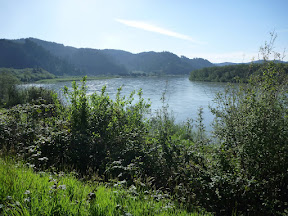
There were so many great things about this place. First was its location, right at the mouth of the Klamath River where it empties into the Pacific. Half of the rooms, plus the dining and sitting rooms look out over the river. This was my view as I ate breakfast Tuesday morning. By Wednesday afternoon a beautiful fog had nestled itself in the trees on the hills. One of the owners told me that sometimes it gets so foggy that they can't even see the river!

This is the road the the Requa Inn is on. See the ocean at the end of the river?

The second great thing about the Requa Inn was the customer service. It's a little family business, owned by a couple, their daughter, and their son-in-law. Everyone was amazingly friendly and helpful. On my first morning I asked for hiking recommendations and one of the owners spent at least 20 minutes helping me pick out good trails and writing down directions. Employees introduced themselves and were happy to chat, but also seemed to know when guests wanted to be left alone. The decor was charming and the staff was meticulous about cleaning. Then there was the food. Breakfast options included all kinds of seasonal fruit and freshly juices, plus local breakfast meat and/or eggs, hotcakes, homemade granola, homemade yogurt, and freshly baked toast. I'm glad I stayed for three days just so I could try everything. There aren't many dining options in Klamath, so I ended up eating dinner at the Requa Inn too. I don't think of myself as a food snob, but their organic, locally produced food ingredients definitely tasted better. I'm sure the fabulous chef didn't hurt. 

I also appreciated the background and social responsibility of the owners. The mother and daughter are members of the Yurok tribe and part of their goal in buying the inn was to create more jobs for people on the reservations and be role models for tribe members who might want to start small businesses. They support other local businesses through the products they use (their food is almost all local, their toiletries are from a local company, etc). The daughter wrote her MPA thesis on Indian education, so she's very active in the tribe and in the local schools. I fully support businesses that do good things and are run by good people. 

My favorite thing about the Requa Inn is a little more specific to me and wouldn't necessarily sway the average person to stay there. One of the owners, the son-in-law, is from New Zealand! I guess anyone would benefit from getting to hear his awesome accent, but I was super-excited to talk to him (or "chat to him," as the Kiwis would say) about all things Godzone. Even better, he had lived in Wellington so we got to reminisce about our favorite places and all the food we can't get here in the US. The most amazing thing was that he had worked in consulting, mediating Maori claims against the crown and since I also did stuff with Maori affairs in the government it turned out that we kind of knew a couple of the same people. Such a small world!

Spring Break 2011: The Drive North

Who knew that California is that big? It takes about 6 hours driving south to get to LA from the Bay Area. If you drive north for 6 hours, you'd think you would make it to another state. It was kind of fun traveling without a GPS or a real map. I got on highway 101 about a mile from my house and just kept going. The drive took me a little longer than expected, but only because there were so many places to stop along the way.

I drove for about 4 hours before making my first stop. The Best of This American Life kept me company, but I was ready for a break. The city (town? village? freeway exit?) of Leggett offered the perfect place to pull over: the southern-most drive-thru redwood tree.

When I paid my entrance fee, the guy pointed out that my ticket allowed me to drive through the tree as many times as I'd like until 8pm that night. As tempting as it was to drive in a very small circle through a redwood tree for 6 hours, I only stayed long enough to stretch my legs and take a picture.

Another 30 minutes or so north of Leggett is the start of an amazing 31-mile scenic drive, the aptly named Avenue of the Giants. It runs parallel to highway 101, traveling along the edge of Humboldt State Park. There was supposed to be an audio tour to accompany the drive, but the box at the start labeled "audio tour" just had a map with no commentary.


I did stop in Humboldt State Park to take a little hike in Founders Grove, home of some big trees (as opposed to other parts of the park?).

The Founders Tree, named in honor of the founders of the Save the Redwoods League. It's really hard to capture the size of these trees on film--the picture below is two pictures stitched together)--but here are some stats: height - 346.1 ft (that's about 10 feet shorter than Niagra Falls); diameter - 12.7ft; circumference - 12.7pi or 40 ft; height to the lowest limb - 190.4 ft. Woah.


I really liked the trees with the burned out insides. I think it's amazing that the trunk can be so hollow but the tree still thrives. All three pictures below are of the same tree (sorry for how creepy my half-face looks in the shot looking upwards).


I was also really into the fallen trees. The exposed roots were so cool. Again, it's hard to demonstrate just how big everything is in photos, so I've tried to provide some scale for each picture below:


Eventually I left Humboldt State Park because I had to make it to my hotel by 8pm. The drive up 101 never stops being amazing. After awhile it moves out of the redwood forests and veers toward the coast. Never a boring drive for sure.

YOLO of the Month: April

True, I didn't really have a YOLO of the month in March. I did spend the night in a YMCA with 110 ninth graders which is something you should only live through once, but I can claim that experience twice (thus far) so I guess it doesn't count. Fortunately, I think my April YOLO counted double.

In an ongoing attempt to fulfill my self-promise of actually seeing the sights that California has to offer, I took a road trip to the north coast and spent a couple of days in the redwood forests. I originally started planning this getaway for spring break two years ago, but of course that was when my car chose to die about a week before my intended departure date. So I got to spend that spring break (and that spring break funding) buying a new car. Not as much fun.

Now finally the trip happened and it was well worth it. I'll put pictures in separate blog posts, but short story: everything was amazing.

Wednesday, April 13, 2011

I Like It When Kids Value Each Other

I make my students work in groups pretty much every day. It's hard work (for me and for them), it can be extremely frustrating (for me and for them) and it's often the most challenging part of my class (for me and for them). But one of my fundamental values as a teacher is that kids learn better when they talk about their ideas. I believe that verbalizing their ideas is the best way for them to make sense of concepts. This means that they have to work in groups and that the groupwork must be structured very carefully. We've all had bad experiences working in teams, so I want my kids to learn now, for lack of a less business-trendy word, what high-performing teams look and feel like. A subset of these goals is that students learn to value each other's ideas and learn to see each other's smarts. Part of being a high-performing team is learning interdependence and finding how each person's unique skills are crucial to the team's success. These teamwork skills will make students better people and I believe happier people down the road.

Without question, my classes this year are the most successful groupworkers I've had. Or, I kind of like to think, this year has been my most successful year of teaching (if I'm teaching kids to do groupwork right, it follows that they're learning the content deeply). I think especially that many of my kids have come to value each other's ideas and that they really listen to each other. Most importantly, I think that a lot of them value everyone's ideas, not just the kids who they deem "smart." Today I felt like I had this confirmed, at least somewhat, when I took a poll on who students want to sit with for their last seat change of the year. Here are some of the highlights:

  • In 3rd period, one of the most requested students was A., a girl who averages C's on tests. Math is challenging for her and in her group she rarely has the brilliant idea that moves the group forward mathematically. But she is the group member who asks the questions other kids are afraid to ask. She's the group member who says, "We need to slow down" and who demands that every step is justified. She's the group member who says, "I need you to explain it another way," and who then repeats back what makes sense to her and what she doesn't understand. I think that the students recognize that having A. in their group means that every idea will be examined and thought through until everyone understands. A.'s not the person who's going to teach you the math, but she's the one who will guarantee that you understand it. 
  • Even though I don't like to compare intelligence levels because I believe everyone is smart, there's one girl who I have to describe as the smartest person in the entire freshman class. She is smarter than me and smarter than most people I know. She could do everything I ask on her own and frankly doesn't need her classmates (or me, probably). Her seat request? To stay with her current team, which includes one of the kids who I think came into this year with the biggest skill deficit in the class. But she feels like she benefits from him. Her other request was to sit with A., the girl I described above. 
  • With the exception of just a few kids, my students did not request to sit with friends. That tells me they recognize that school is for learning, not for socializing. Of course they picked kids who they enjoy working with, but enjoyment did not seem to be correlated to who they sit with at lunch. I was even more pleased that a number of kids specifically requested not to sit with their friends. I got a lot of, "I love her but we talk to much!"
  • The kids who were requested the most are students who especially skilled at including other kids in groups. I have a lot of kids who are willing to put their ideas out there, but fewer who will ask their teammates what they think. The "popular" kids were the ones who are super-patient, will ask for everyone's opinion, and who will force their teammates to explain. What a powerful thing at an early age to be able to recognize the people who bring out the best in you.
At the end of my last class as kids were filling out this survey, one boy held up to me what he'd written and sighed, "Can't we just do this?" I expected something annoying like, "Not do math anymore" or "Have class outside." Then I almost cried when I saw what he wrote: "One big table with everyone."